 Catan Trainer
Catan Dice Probability: The Odds of Every Roll, and What the Pips Really Mean
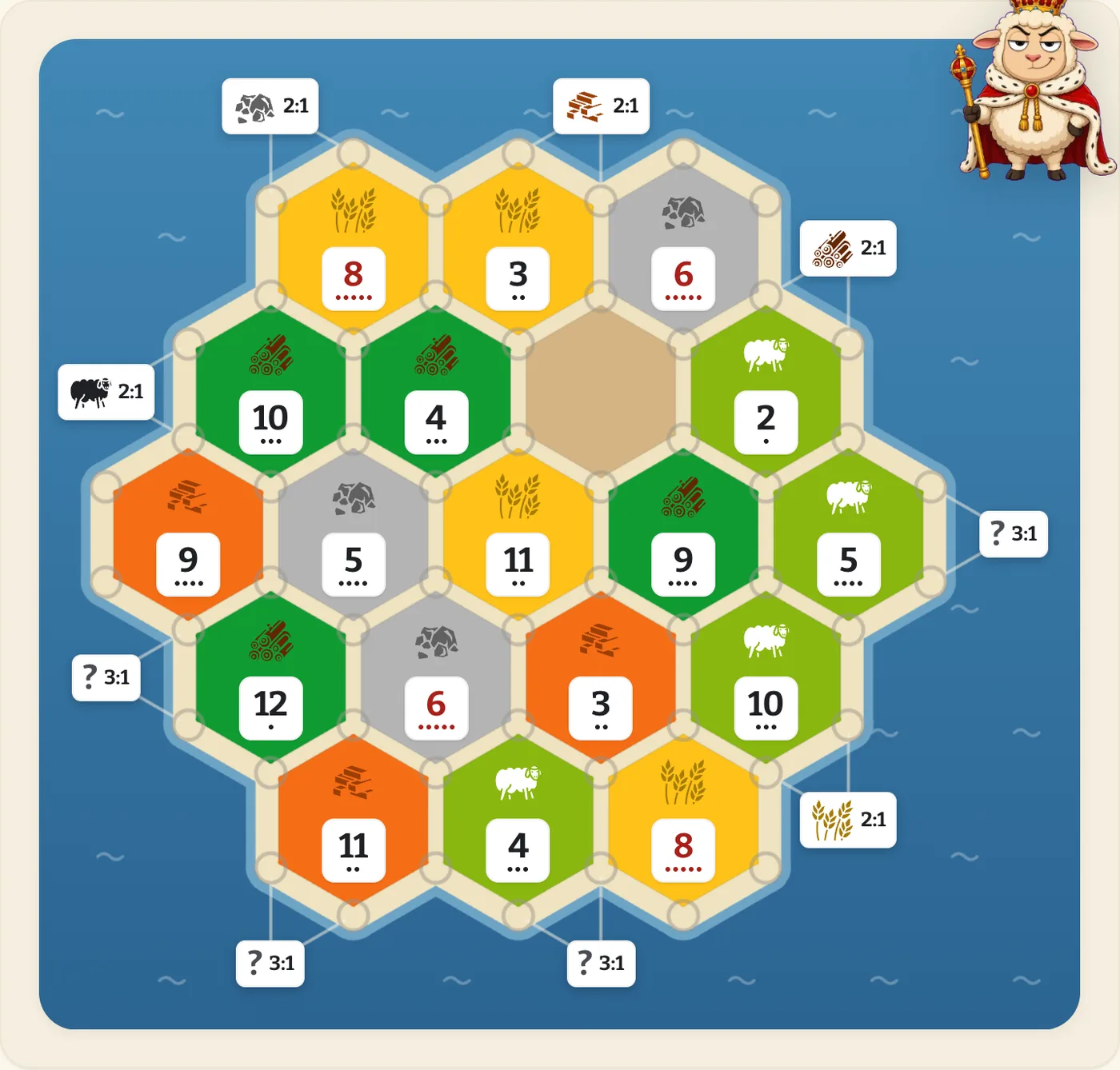
Every number token in Catan carries a small row of dots. Those dots are the whole game's probability table in disguise: they tell you exactly how often each hex will pay out, and adding them up around a corner tells you how strong a settlement spot is before anyone rolls. This post gives you the full chart, the odds behind it, how often each number actually shows up in a real game, and the counting habit that separates players who "like the look of a spot" from players who know what it produces.
The odds of every Catan dice roll
Catan rolls two six-sided dice and adds them. There are 36 equally likely combinations, but the totals are not equally likely: there is exactly one way to roll a 2 (1+1) and six ways to roll a 7 (1+6, 2+5, 3+4, 4+3, 5+2, 6+1). The chart shows how the 36 combinations spread across the eleven possible totals.
| Roll | Ways to roll it | Probability | Pips on the token | Hits in an 80-roll game |
|---|---|---|---|---|
| 2 | 1 of 36 | 2.8% | • 1 | about 2 |
| 3 | 2 of 36 | 5.6% | •• 2 | about 4 |
| 4 | 3 of 36 | 8.3% | ••• 3 | about 7 |
| 5 | 4 of 36 | 11.1% | •••• 4 | about 9 |
| 6 | 5 of 36 | 13.9% | ••••• 5 | about 11 |
| 7 | 6 of 36 | 16.7% | none — robber | about 13 |
| 8 | 5 of 36 | 13.9% | ••••• 5 | about 11 |
| 9 | 4 of 36 | 11.1% | •••• 4 | about 9 |
| 10 | 3 of 36 | 8.3% | ••• 3 | about 7 |
| 11 | 2 of 36 | 5.6% | •• 2 | about 4 |
| 12 | 1 of 36 | 2.8% | • 1 | about 2 |
The "hits" column uses a typical four-player game of roughly 80 rolls; shorter games scale down, longer ones up. Notice the shape: a 6 or 8 pays out about five times as often as a 2 or 12, and about 1.6 times as often as a 4 or 10. A hex on a 5 is worth four-fifths of a hex on a 6, not "a bit less."
What the pips under each number mean
Pips are the dots printed under every number token. A token's pip count equals the number of two-dice combinations that roll it: one dot on the 2 and 12, five dots on the 6 and 8. The 6 and 8 are printed in red because they are the most productive numbers on the board. There is no 7 token: a seven moves the robber and forces anyone holding more than seven cards to discard half of them, so the most common roll in the game is the one that builds nothing.
The pip count is a rate. Over 36 rolls a 5-pip hex is expected to pay out five times; a 1-pip hex, once. That makes pips additive: a settlement touching a 6, a 9 and a 4 is expected to produce 5 + 4 + 3 = 12 cards per 36 rolls, one card per adjacent hex each time its number comes up. Count the dots around a corner and you have that corner's production per 36 rolls. Nothing else on the board is that easy to measure.
How to count a settlement spot
Before you place, do this for every corner you are considering:
- Add the pips of the hexes touching the corner. A corner touches up to three hexes. Desert and sea count for nothing.
- Rank the open corners by that total. On most boards the best first placements sit at 10 to 13 pips. Ten is the floor you should expect from a first settlement; 12 or 13 is elite.
- Only then look at what the pips are made of: which resources, whether they are scarce on this board, and what plan they point at. Production first, identity second, because a spot with 8 pips of exactly the resources you wanted is still a slow spot.
Why 13 is close to the practical ceiling: under the standard variable-setup rules the two red numbers (6 and 8) are not placed next to each other, so a corner touching both a 6 and an 8 is rare. A 6 next to a 5 and a 9 gives 13; a 6, 8 and 5 corner (14) mostly appears in beginner fixed layouts or when the red-number rule is switched off.
Why 6 and 8 are the best numbers, and why you still want a spread
Each red number pays out on 13.9% of rolls, so a corner on both a 6 and a 5 (9 pips) beats one on a 4, a 10 and an 11 (8 pips) even though the second touches more hexes. Yet strong players deliberately avoid stacking their whole position on the same two numbers, for two reasons that the pip count alone does not show.
The robber goes where the pips are. When a 7 comes up, the player moving the robber parks it on the hex that hurts you most, and that is usually your best 6 or 8. A position that is all red numbers is a position that gets blocked on the hex that carries it. Two settlements that each lean on a different strong number are harder to shut down than two settlements that both live on the same 8.
Variance is real over 80 rolls. The table says a 6 hits about 11 times a game, but the standard deviation on that is about three. Some games your 6 hits five times. Spreading your position across five or six distinct numbers does not raise your expected production, but it smooths the games where one number goes cold, and in Catan a dry stretch of four turns often decides who reaches ten points first. When you place your second settlement, count the distinct numbers across both spots: three is a serious weakness, four is a downside, five or six is healthy. The exception is deliberate: a 6 on wheat and a 6 on ore that hit together is a city every time that number rolls, and that duplication is a feature, not a bug.
Numbers are never "due"
The dice have no memory. If the 8 has not rolled in twelve turns it is exactly as likely to roll next turn as it ever was: 5 in 36. Players talk themselves into placements on cold numbers ("the 8 is overdue, this spot is about to go off") and out of placements on hot ones ("the 6 has hit six times already, it's done"). Both are the gambler's fallacy. The pips are the only forecast you get, and they do not change during the game.
The one thing that does change is who is on which number. Which numbers your opponents share with you decides how crowded a payout is and how often the robber lands near you. That is a reason to check the board's settlements, not the dice history.
Pips are not the whole value of a hex
Two spots with the same pip count are rarely equal, because the cards they produce are not equally useful. Cities cost three ore and two wheat, development cards cost one each of ore, wheat and sheep, and a road costs wood and brick, so late-game wealth runs on wheat and ore while early tempo runs on wood and brick. As a tiebreaker most competitive players value the resources roughly wheat, then ore, then brick, then wood, then sheep, and then adjust hard for the board in front of them: a 3-pip ore hex on a board with only 6 total ore pips is a scarce asset, while a 5-pip sheep hex on a board drowning in sheep is production you will struggle to spend.
So the full method is: count pips first, then weight them by how valuable and how scarce each resource is on this board, then ask what plan the mix supports. That is exactly the order we walk through in our step-by-step guide to the first two settlements, and it is the order the placement analysis in Catan Trainer follows when it grades a spot.
A worked example
Say you are choosing between two open corners:
- Corner A: 6 wheat, 9 ore, 4 sheep. That is 5 + 4 + 3 = 12 pips across three resources, with the two most valuable resources on the two best numbers.
- Corner B: 8 wood, 5 wood, 10 brick. That is 5 + 4 + 3 = 12 pips too, but 9 of them are wood and the mix only builds roads and settlements.
Same production. Corner A funds cities and development cards on its own and pairs with almost any second settlement. Corner B is a committed road-building position that needs a wheat source next turn or it stalls at settlements it cannot upgrade. Neither is wrong, but only the pip count is the same; the plan, the risk and the ideal second pick are different. Counting pips gets you to the right shortlist. The rest of the decision is about what the pips are made of.
Quick reference
- Two dice, 36 combinations. Probability of a total = ways to roll it ÷ 36.
- Pips on a token = ways to roll that number. 6 and 8 have five; 2 and 12 have one.
- 7 is the most common roll (16.7%) and produces nothing. It moves the robber and triggers discards above seven cards.
- A settlement's pips = the sum of its hexes' pips. Aim for 10 or more on a first placement; 12 to 13 is elite.
- Spread your two settlements over five or more distinct numbers unless a duplicate deliberately builds a city on one roll.
- Numbers are never due. The pips are the only forecast.
Practice reading the pips on real boards
Catan Trainer deals you board after board, you place, and an AI coach shows you the best available spot and argues the difference: pips, scarcity, resource value, ports and your outs. Free to try.
Train your placements →