 Catan Trainer
Catan Placement Strategy: 7 Lessons from the 2025 World Championship Final
In April 2025, four national champions sat down in Stuttgart to decide the Catan World Championship on a brutal board: three ore hexes stacked in one corner, thin wheat, and port placement that punished lazy openings. Before a single die was rolled, most of the game had already been decided. This post walks through how Canada's Kohulan Narendran, Mexico's Raul Gimenez, Italy's Guido, and Hong Kong's David Luk placed their opening settlements — and turns their decisions into placement principles you can use tonight.
Two of the best breakdowns of this final come from DandyDrew — the 2024 US national champion, who played David Luk in the semifinal of this very tournament — and Treeckosaurus, who interviewed the finalists about their picks. Both videos are embedded below and worth your time. What follows draws on their analysis plus the placement principles we've built Catan Trainer around.
DandyDrew's finals breakdown — he calls this "an insanely challenging triple ore pile board."
Lesson 1: Start from the highest-production spots — always
Placing first, Kohulan took the 9/5/10 with double ore and wheat. Both analysts open their breakdown the same way: it's one of the highest-producing intersections on the board. DandyDrew is explicit about the method:
"It's very important in your placement strategy to identify all the high producing spots first and then start your evaluation from there."
This is the single most common gap between casual and competitive play. Casual players scan for resources they like. Champions count pips — the little dots under each number that show how many of the 36 dice combinations roll it — and rank every legal intersection by total pips before thinking about anything else. A 6 and an 8 carry five pips each; a 2 or 12 carries one. On most boards you want your first settlement in double digits.
Lesson 2: Scarce resources are now-or-never
Why the 9/5/10 over the other high-pip options? Because it held the best ore on a board where ore was concentrated and contested. DandyDrew again:
"Ore is one of the best middle-to-late-game resources. It's really one of those situations where you either take it now or you lose the opportunity in the game."
Every board has a supply curve. Count the total pips behind each resource across the whole board before you place. If a valuable resource is thin — three hexes or fewer, weak numbers — the intersections that produce it well are effectively expiring assets. Kohulan claimed the best ore with the very first placement; Italy's Guido grabbed the second-best ore spot (the 6/5/11) two picks later, and by then the window was closed. Raul, placing second, faced the problem directly: every path either gave up ore or gave up wheat, and as Treeckosaurus put it, whoever controlled the 9/5/10 would spend the whole game trading ore for everything else.
Lesson 3: Wheat and ore decide the endgame
The final score tells the story: Kohulan won with four cities, one settlement, and a victory point card. Cities cost three ore and two wheat each. The player who secured the board's best ore on pick one converted it into the exact win condition that ore feeds.
This matches the resource hierarchy top players use as a tiebreaker: wheat > ore > brick > wood > sheep, adjusted for what the board actually offers. Wood and brick win the early game; wheat and ore win the game. When two spots look close, lean toward the one whose strong numbers sit on wheat or ore.
Lesson 4: Know your outs before your first pick
Treeckosaurus highlights something subtle about Kohulan's first placement: before committing, he had already mapped what would be left for his second settlement if the seven best spots disappeared — which, placing first in a snake draft, is exactly what happens. His fallback options were coastal two-hex spots, and he had already decided he could live with them.
"Before you place your first settlement, you always have to know your outs for your second settlement."
In Catan's snake draft, first position places 1st and 8th. Your first pick is really a package deal with your worst-case second pick. If taking the flashiest spot leaves you choosing among scraps on the way back, a slightly weaker first pick with protected outs often wins the opening.
Lesson 5: A road is a bet — price it like one
Guido took the 6/5/11 and pointed his road toward the 9/3/11, a spot he did not control. Then, with his second placement, he doubled down: instead of a safe high-production pick he placed directly on the 8/10 sheep port, betting his whole expansion on the 9/3/11 staying open. DandyDrew's verdict: "If orange takes the 9/3/11, white's game is effectively finished." Treeckosaurus was blunter — every one of Guido's expansion options now sat two roads away.
Guido got away with it: the 9/3/11 stayed open, he claimed it mid-game, and rode longest road to eight points. But both analysts flag the same principle — when you point a road at a contested spot, you're wagering your position on your opponents' cooperation. The safer play (pointing at the guaranteed 4/11) gives up upside for certainty. Know which bet you're making, and make it on purpose.
Lesson 6: A 2:1 port is only as good as the surplus behind it
The most instructive placement of the final was the last one. Kohulan's final settlement went on the 6/2 ore port — a two-hex, low-pip spot that most club players wouldn't glance at. But he already owned the board's biggest ore pile. A 2:1 port trades that resource away, so its value is exactly the surplus you can push through it. An ore port on top of the best ore on the board is a production multiplier; the same port without ore behind it is dead weight.
Contrast that with his first pick's wood port, which DandyDrew flagged as "questionable if it's useful or not" until the second settlement existed — the port's value literally couldn't be evaluated without knowing the rest of the position. That's the discipline: never credit a 2:1 port for the resource it's named after. Credit it for the surplus you'll actually feed it.
Lesson 7: Placement is also a negotiation
With his final pick, Kohulan had three real options — including the 8/4, which would have gutted David Luk's expansion plans. He chose the 6/2 instead. DandyDrew calls it "quite the diplomatic decision": by not taking spots from White or Blue, he avoided making early enemies on a board where he was already the production leader. Meanwhile David's own double placement (the 8/4/3 and 6/4/3) was partly a denial play — as DandyDrew notes, taking the 8/4 away from a rival shifts that rival's entire strategy.
Your placements shape who robs you, who trades with you, and who races whom. Sometimes the best spot on the board isn't the best spot for your game.
Treeckosaurus interviewed the finalists about their placement reasoning — including Kohulan's own explanation of the ore-port pick.
The checklist, in order
- Count pips. Rank every open intersection by total production. Start your evaluation from the top.
- Check the board's supply. Which resources are scarce? Scarce + valuable = take it now or never.
- Weigh wheat and ore heaviest. They fund cities and development cards — the win conditions.
- Map your outs. Assume the best spots vanish before your next pick. Can you still live with what's left?
- Point roads at spots you can actually claim. Every contested road direction is a bet.
- Only value 2:1 ports you can feed. The port trades your surplus away; no surplus, no port.
- Read the table. Denial, diplomacy, and future trade partners are part of the placement.
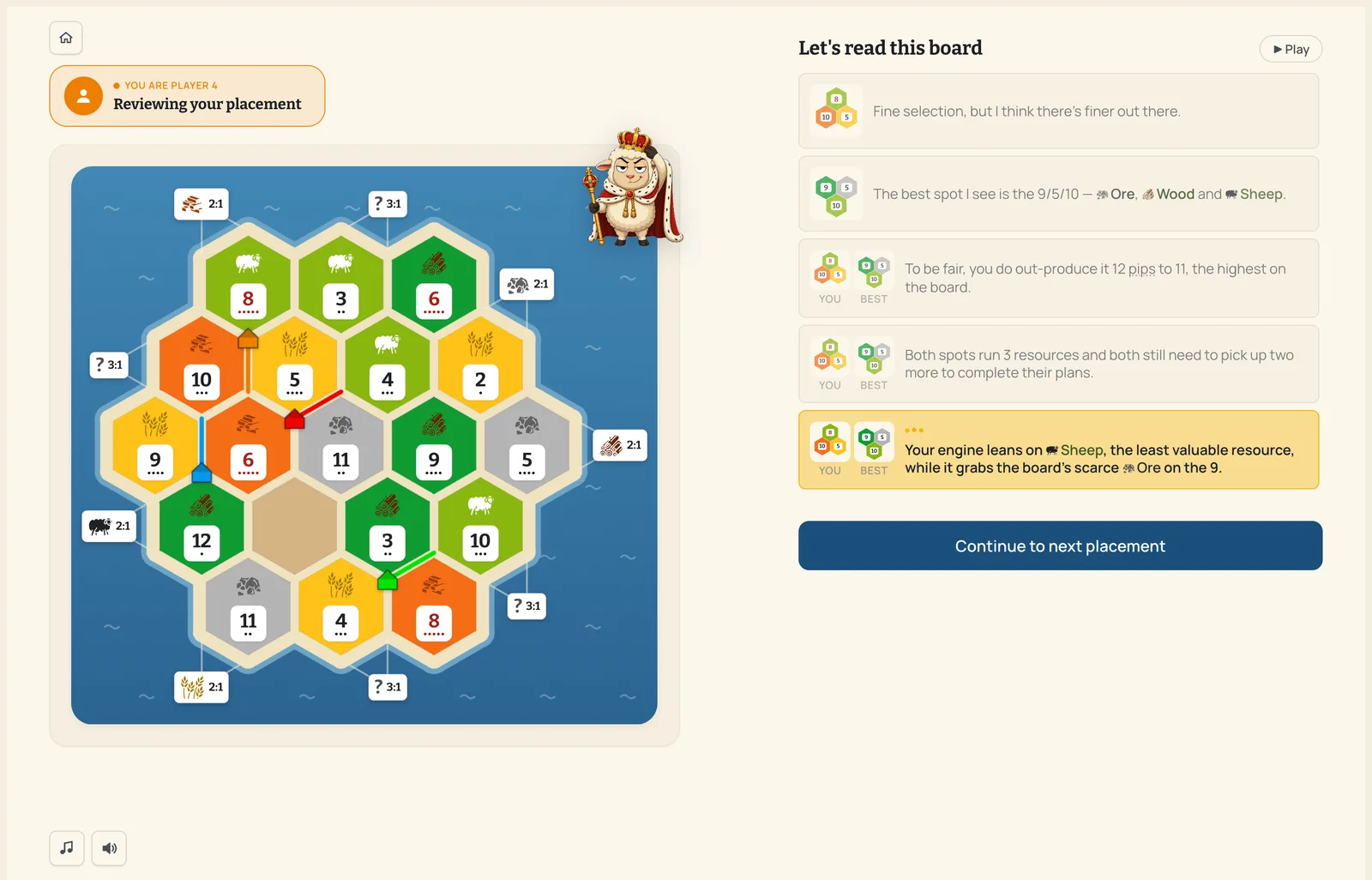
Turning film study into skill
Watching championship analysis is the fastest way to learn what good placement looks like. The gap is reps: you get exactly two opening placements per game, there's no one at the table to tell you which of the 50+ legal intersections was actually best, and by the time the game ends you've forgotten why you placed where you did.
That's the gap Catan Trainer was built to close. It deals you board after board, you place, and an AI coach trained on these same championship placement principles tells you straight up whether you found the best spot — and argues it: pips, scarcity, resource synergy, port fit, your outs. It'll tell you when your pick was perfect, and it will absolutely tell you when it's, in its words, "kinda trash."
Want to actually get better at placements?
Play unlimited opening placements against AI opponents and get championship-grade feedback on every single one. Free to try.
Train your placements →