 Catan Trainer
Catan Placement Mistakes: 6 Blunders from Championship Finals
The comforting thing about studying championship Catan is discovering that national champions blunder their openings too — on stream, at the world finals, with a trophy on the line. The useful thing is that their mistakes are legible: analysts have picked them apart move by move, so you can learn to spot the same patterns in your own games. Here are six placement mistakes drawn from real championship finals, with the reasoning behind each.
Mistake 1: Building your plan on a spot you don't control
At the 2018 World Championship final in Cologne, Denmark's Jan — playing second — used his second placement on the 9/12, a five-pip spot, as part of an elaborate plan: cut off a rival with his starting road, win the race to the 6/11/12, then chain into two ports. When DyLighted asked him about it afterward, Jan called it "both a bold and logical move" — and laid out a line where he'd be "almost unbeatable."
The problem: every step of that plan depended on winning races he wasn't favored to win, from a five-pip production base. DyLighted's analysis is surgical — even after the cutoff, Jan was still racing a wheat-rich opponent who could simply out-trade him for the materials. The plan was beautiful; the position paying for it produced five pips.
DyLighted's breakdown of the 2018 world final — 25 hours of research on two placement mistakes.
Mistake 2: "Hurting two players" that only hurts one
The final placement of that same 2018 game: Colombia's José, with the last pick, placed on the 6/11/12 — a spot that looked like it damaged two opponents at once. DyLighted's verdict: "a huge mistake for several reasons." Only one opponent could ever have taken the spot, so it hurt exactly one player — the one who was already weakest. Worse, it left José with ore, brick, and sheep: three resources that don't combine into any build, and no wheat at all.
The alternative — the 4/5/11 — gave him wood to pair with his brick, coordinated numbers so a single roll delivered a road, sheep split across two hexes (much harder to rob), and a path to wheat. And crucially, it would have left his two opponents to race each other for the contested spots:
"Induce, not reduce, races between your opponents. They'll be robbing each other — and trading with us instead."
Mistake 3: Ignoring whether your resources build anything together
José's 6/11/12 error had a second layer that deserves its own number, because it's the most common placement mistake at every skill level: he ended the draft with a hand profile — ore, brick, sheep, no wheat — that doesn't fund any build path. Roads need wood+brick. Settlements need wood+brick+wheat+sheep. Cities need ore+wheat. Development cards need ore+wheat+sheep. Every one of those recipes was broken.
DyLighted's rule from that video has become a community proverb: "No wheat equals defeat." Wheat appears in three of the four things you can buy. When you evaluate a spot, don't count resources — trace the actual builds your combined position can afford.
Mistake 4: Counting pips but not exits
At the 2022 Canada National Championship final, the fourth-seat player took two settlements totaling seventeen pips — respectable production on paper. DandyDrew's analysis flags the real problem: "no viable way to easily build to expand his setup." No port leverage, no clean road-settle, no space to claim. All engine, no road out of the driveway.
His proposed alternative for that seat gives up nothing in production but completely changes the game: a double placement that creates space — best wood and brick on the board, a port for flexibility, and room to connect roads for a longest-road game. As he puts it, for a road player "the ability to control space or a section of the board is a massive asset."
Mistake 5: Placing into a race you've already lost
From the 2021 US National Championship final board, analyzed placement-by-placement by Hakuna Matata: a mid-draft pick that looked like a tidy ore-wheat-sheep setup — but whose entire viability depended on later claiming one specific wheat-port expansion spot. The analysis pulls no punches: by narrowing what remained for the last-placing player, the pick "pretty much guaranteed" that player would take the very expansion spot the plan needed.
This is the draft-order blindness mistake: evaluating a spot as if the board were frozen, when three other players still get placements and each one responds to yours. The strongest placements are robust to what happens next; the weakest hand your opponents a script for ruining you.
Mistake 6: Auto-taking the biggest number cluster
One from the other direction — a "mistake" a champion conspicuously didn't make. In that same 2022 Canada final, Elise, placing second, passed on the board's biggest producer (the 8/9/5) and took the 8/9/4 instead. Autopilot says take the pips. Her reasoning, as DandyDrew reconstructs it: the 8/9/4 secured the board's scarce brick, kept the third player from getting a free ride, and preserved her ability to pivot into a longest-road game later — which is exactly how she won the championship, taking longest road on the final play of the game.
"Most people would auto-place the 8/9/5 without considering the board state as it develops. The more you practice calculating, the better your strategic understanding will become."
The biggest number cluster is the right pick most of the time — which is precisely what makes the exceptions expensive. Scarcity, position, and your win condition can all outrank two extra pips.
The pattern behind all six
Every one of these blunders survives contact with a simple checklist — production, resource synergy, scarcity, ports, outs, draft order — applied honestly. None of these players lacked the knowledge. What failed was evaluation under pressure: with a clock ticking and a trophy at stake, they pattern-matched to a plan and skipped the check that would have killed it.
That's trainable. It just needs reps with feedback — which is the one thing a normal game of Catan never gives you, because nobody at the table knows what the best placement actually was.
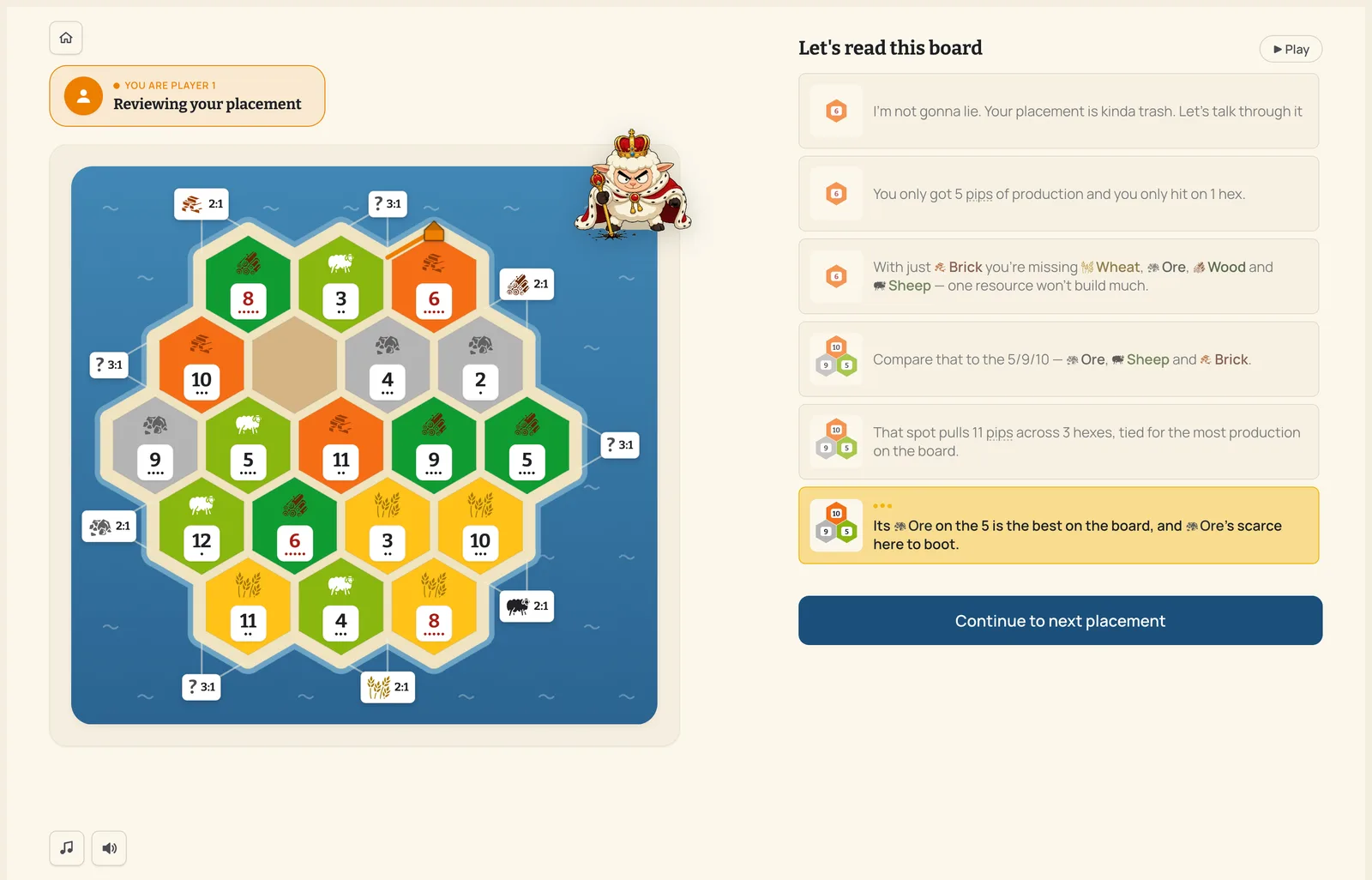
Find out which of these mistakes you make
Place openings on unlimited boards and get an honest AI verdict on every one — including exactly what the best spot had that yours didn't. Free to try.
Test your placements →