 Catan Trainer
How to Get Better at Catan: A Practice System That Actually Works
Most Catan players plateau for the same reason: they only ever play. Playing more games makes you comfortable; it doesn't make you good, because Catan hides the quality of your decisions behind dice. You can place terribly and win on rolls, or place perfectly and lose to a robber parked on your 8. Without feedback, you learn the wrong lessons from both. Here's a practice system that fixes that — the same loop that works in chess and poker, adapted for Catan.
Why placement is the skill to train first
Of all the decisions in a game of Catan, the two opening placements are the highest-leverage and the most trainable. They're made with complete information — no hidden cards, no luck yet — and they constrain everything after: your production, your trade leverage, your win condition, even who robs you. When analysts break down championship finals, placement analysis is most of the video. The 2025 world final was effectively decided when Canada's Kohulan Narendran claimed the board's best ore with the first placement and converted it into four cities — we broke down that game placement-by-placement in this post.
Placement is also where casual habits are most stubborn: favorite resources, pretty number clusters, "my lucky 6." Champions instead run a checklist — production pips, resource scarcity, wheat/ore priority, port fit, expansion outs, draft order. If you only train one thing, train the checklist until it's automatic.
Step 1: Learn the principles (one evening)
You can absorb the core placement principles in a single sitting:
- Count pips, not vibes. Rank spots by total production dots. First settlements usually want 10+.
- Take scarce, valuable resources now. The best ore or wheat on a thin board is now-or-never.
- Wheat and ore win endgames. They fund cities and development cards — weight them accordingly.
- Three resources beats two on your first placement — unless the two are elite wheat and ore, the one classic exception.
- A 2:1 port is only worth the surplus you feed it. An ore port with no ore is decoration.
- Know your outs. Your first pick is a package with your worst-case second pick.
Our two companion posts go deeper, with the championship receipts: seven lessons from the 2025 world final and six placement mistakes champions actually made.
Step 2: Study championship film (ongoing)
Championship analysis videos are the closest thing Catan has to a master-game database. The channels doing the best work — DandyDrew (2024 US national champion), Treeckosaurus, and DyLighted — don't just narrate; they argue every placement against its alternatives, which is exactly the mental motion you're trying to build.
Watch actively: pause before each placement is revealed, choose your own spot, then let the analysis grade you. One number from this genre worth internalizing, via Treeckosaurus's research: players who get both monopoly cards played in a game win over 52% of the time — a reminder that development cards, funded by ore and wheat, quietly decide far more games than dice do.
Step 3: Drill placements with real feedback
Here's the bottleneck with film study and real games alike: volume and feedback. A full game gives you two placement decisions and zero evaluation. Nobody at your table can tell you whether the spot you took was the 1st-best or the 9th-best of the fifty-plus legal intersections. In chess you'd check the engine. In Catan, until recently, there was nothing to check.
This is the exact gap Catan Trainer exists to fill. It's a Catan AI coach for the opening: it deals you a fresh board, seats you against AI opponents in a real snake draft, and after every placement it evaluates all of your options — production, scarcity, resource synergy, port direction, your remaining outs — and gives you a straight verdict: best spot on the board, second-best, or worse. Then it argues the case the way a championship analyst would, ending with what the best spot had that yours didn't. A skill rating tracks whether you're actually improving across sessions.
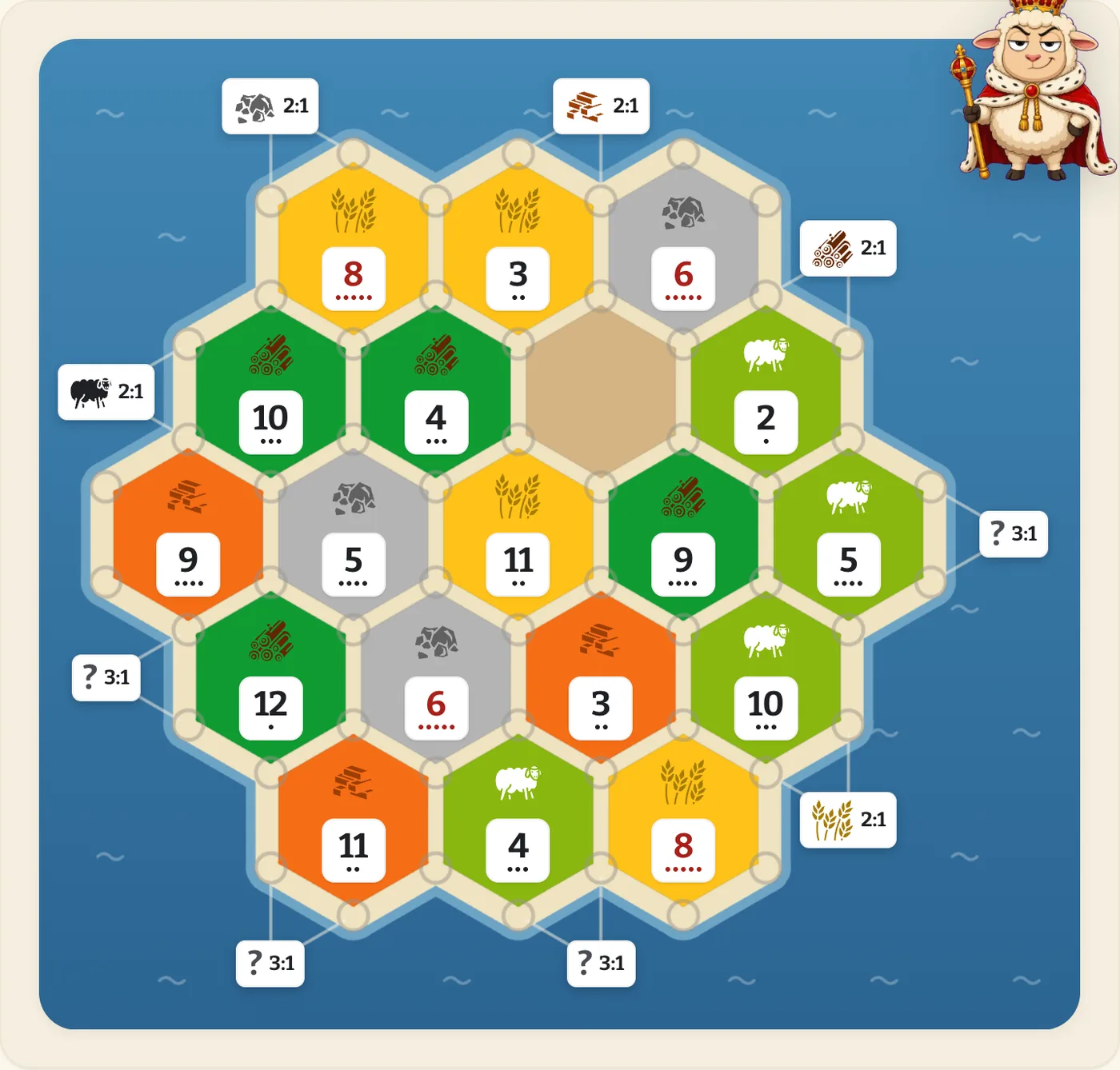
Twenty minutes of drills is twenty-plus graded placements — more evaluated reps than a year of weekly game nights.
Step 4: Review your real games
Practice boards build the skill; your real games tell you whether it's transferring. If you play on Colonist, Catan Trainer can import your finished games and run the same analysis on the placements you actually made under real conditions — the verdict, the comparison, the spot you should have taken.
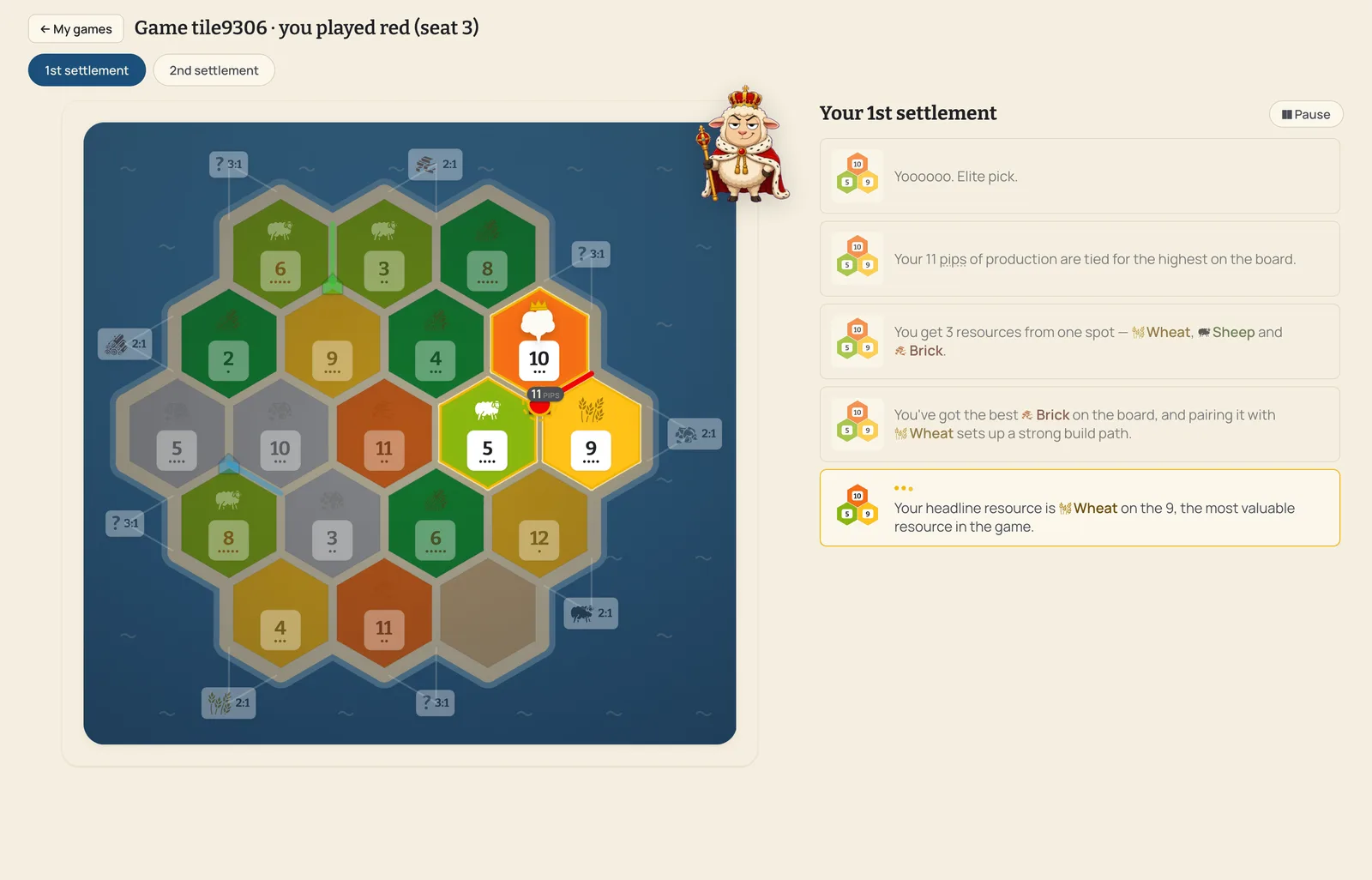
The review habit matters more than the grade. Poker players call it "off-table work"; it's where the actual rating gains live.
Step 5: Play with intent
Finally, change how you play your regular games. Two habits from championship analysis:
- Declare a win condition early. The 2022 Canada final was won by the player whose placements pointed at longest road from pick two. As DandyDrew puts it: know your win condition, and know who's playing for what.
- Predict the table, not just the board. Who will need your surplus? Who are you feeding if you make this trade? The 2018 world final was decided by players mispredicting races — we covered the details here.
Frequently asked questions
Is Catan a game of luck or skill?
Both — but skill compounds. Dice decide single games; decision quality decides win rates. The same names keep reaching national finals for the same reason the same poker players keep cashing: over enough games, the edge from better placements, trades, and robber decisions dominates variance.
How long does it take to get noticeably better?
With a feedback loop, weeks rather than years. The placement checklist is learnable in an evening; making it automatic takes a few hundred graded reps — a couple of weeks of short daily sessions in a trainer, versus years of unexamined game nights.
Is there an AI for Catan like chess engines?
Catan doesn't have a solved engine the way chess does — hidden information and trading make it harder. What exists now are AI evaluation tools for the parts of the game with complete information. Catan Trainer is exactly that for the opening: an AI built on championship placement principles that ranks every legal spot on the board and coaches you through the comparison.
Start the feedback loop
If you actually want to get better at placements — not just read about it — run the drill. Place, get graded, learn, repeat. Free to try.
Try Catan Trainer →