 Catan Trainer
Colonist.io Strategy: How to Rank Up (Placement First, Then Everything Else)
Colonist.io is where most competitive Catan gets played now: short games, a rating next to your name, and opponents who have seen ten thousand boards. If your rating has been flat for months, the usual advice ("trade better", "watch the robber") is not where the points are. The points are in the first ninety seconds. This guide explains why online Catan is decided at placement, what actually changes between ranked 1v1 and four-player, the habits that separate players who climb from players who plateau, and how to turn your own game history into a coach.
Why Colonist games are decided before the first roll
Online, every game is played by people who know the rules, play fast, and rarely make a blunder in the middle of the game. That flattens the mid-game: good trades are hard to find because nobody is giving them away, and the robber is always on someone's best hex. What is left to separate players is the one decision that is made with no information from the dice at all: where the first two settlements go.
A first settlement that is two pips short of the best available corner produces roughly 6% fewer cards for the whole game. A position with no wheat cannot build settlements or cities without trading for it at 4:1. A road pointed at a port that another player will reach first is a free road wasted. None of these errors feels like a mistake at the time, and all of them are invisible by turn ten, when you are "just unlucky with the dice." Players who climb have stopped being unlucky at placement. Everything else in this guide follows from that.
1v1 and four-player are different games
Colonist's ranked ladder is mostly 1v1, and the official guides for it are worth reading (Colonist's own 1v1 guide is the best). The placement principles do not change, but the weights do.
| Ranked 1v1 | Four-player | |
|---|---|---|
| Points to win | 15. You will need longest road, largest army or development-card points; plan the route at placement. | 10. A city engine alone can get there. |
| Trading | Almost none. Every resource you do not produce costs 4:1 or a port. | Real. A missing resource can be traded for, at a price. |
| The robber | Lands on you every 7 your opponent rolls. One dominant hex is a liability. | Spread across three opponents; the leader eats it. |
| Coverage | All five resources, or a 3:1 port, is close to mandatory. | Three good resources and a plan beats five thin ones. |
| Number spread | Six distinct numbers across two settlements is the goal; a duplicated 8 gets blocked all game. | Five or six is healthy; a deliberate wheat/ore duplicate is fine. |
| Tempo | Production rate decides it: whoever produces more early usually produces more all game. | Position and plan decide it; a slower start can win with a better engine. |
The practical difference is that 1v1 punishes concentration. A four-player position built on a 6 wheat and a 6 ore is a city engine; the same position in 1v1 is a target that stops producing every time your opponent rolls a 7, which is one roll in six. In 1v1, count distinct numbers before you count pips.
Reading a Colonist board fast
You have a placement timer, so the evaluation has to be a habit, not a calculation. In order:
- Pips first. Add the dots on the hexes around each open corner. The strongest corners on most boards are 11 to 13 pips. Anything under 10 for a first settlement needs a very good reason. (If the dots are new to you, start with what pips are and why they add up.)
- Scarcity second. Total the board's pips per resource. Ore and wheat are usually the thin ones; a board with only one real ore hex makes that corner now-or-never.
- Plan third. Ore, wheat and sheep build cities and development cards; wood and brick build roads and settlements. Your strongest numbers tell you which game this board wants you to play.
- Ports last, and honestly. A port is yours only when a settlement sits on it. From a fresh settlement the nearest legal port corner is two roads and a settlement away, so a port "nearby" is a plan, not an asset. The full rule is in our port strategy guide.
Then project the draft. Which corners will the opponents take before your second pick? If the honest answer is "the only wheat on the board," your first pick should probably be that wheat, even at a pip or two less.
Five habits of players who climb
1. They count pips on every open corner, every game
Not the corners that look good. Every one. The best spot on a board is often the ugly one touching a 5, a 9 and a 4 (11 pips) rather than the pretty one on a 6 and two 11s (9 pips). After a few hundred boards the counting becomes instant, which is why a timer stops being a problem.
2. They choose the second settlement for the combined position
The second placement is not "another good corner." It is the corner that completes the first: adds the missing resource, pairs brick with wood or wood with brick, spreads the numbers, and deals a starting hand you can spend on turn one. Wood plus brick at your second settlement is a road in hand before anyone rolls, which in 1v1 is often the difference in a race for a corridor.
3. They aim the free roads at something they can claim
Each placement road is the only free one you get. Pointing it at a contested corner is a bet that your opponent will not take it, and on Colonist they will. Point it toward the coast, an open corner, or a port you can actually feed. A road that goes nowhere is worth less than a road you did not need to build.
4. They know where their next settlement is before the first roll
Players who plateau build when they have the cards. Players who climb know on turn one which corner they are expanding to, which two roads get them there, and what they will do if it gets taken. That plan decides what to trade for and when to spend a development card, so it feeds every later decision.
5. They review their losses
Colonist keeps the log of every game. The players at the top of the ladder re-watch their openings: was there a higher-pip corner, a scarcer resource, a port they could have reached? Doing that for your last ten losses teaches more than the next fifty games played on autopilot, because the opening is the one decision you can judge without the dice getting in the way.
Mistakes that are specific to Colonist
- Letting the timer place for you. Running out the clock hands you a corner the client picked, not you. If you are regularly timing out, the fix is the counting habit above, not a faster mouse.
- Treating 1v1 like a four-player game. A three-resource city engine with no port and no way to get wood and brick cannot reach 15 points. Cover the board or hold a 3:1.
- Stacking on one red number. In 1v1 your best hex is where the robber lives. Two settlements that share an 8 share a problem.
- Reading the opponent's rating instead of the board. A higher-rated opponent placed better, not luckier. The board is the same for both of you.
- Blaming the dice. The most common roll is a 7 and it produces nothing for anyone. A 6 hits about 11 times in 80 rolls with a standard deviation of about three; some games it hits five. Positions spread across more numbers survive those games. Numbers are never due; see the full probability table.
Turn your game history into a coach
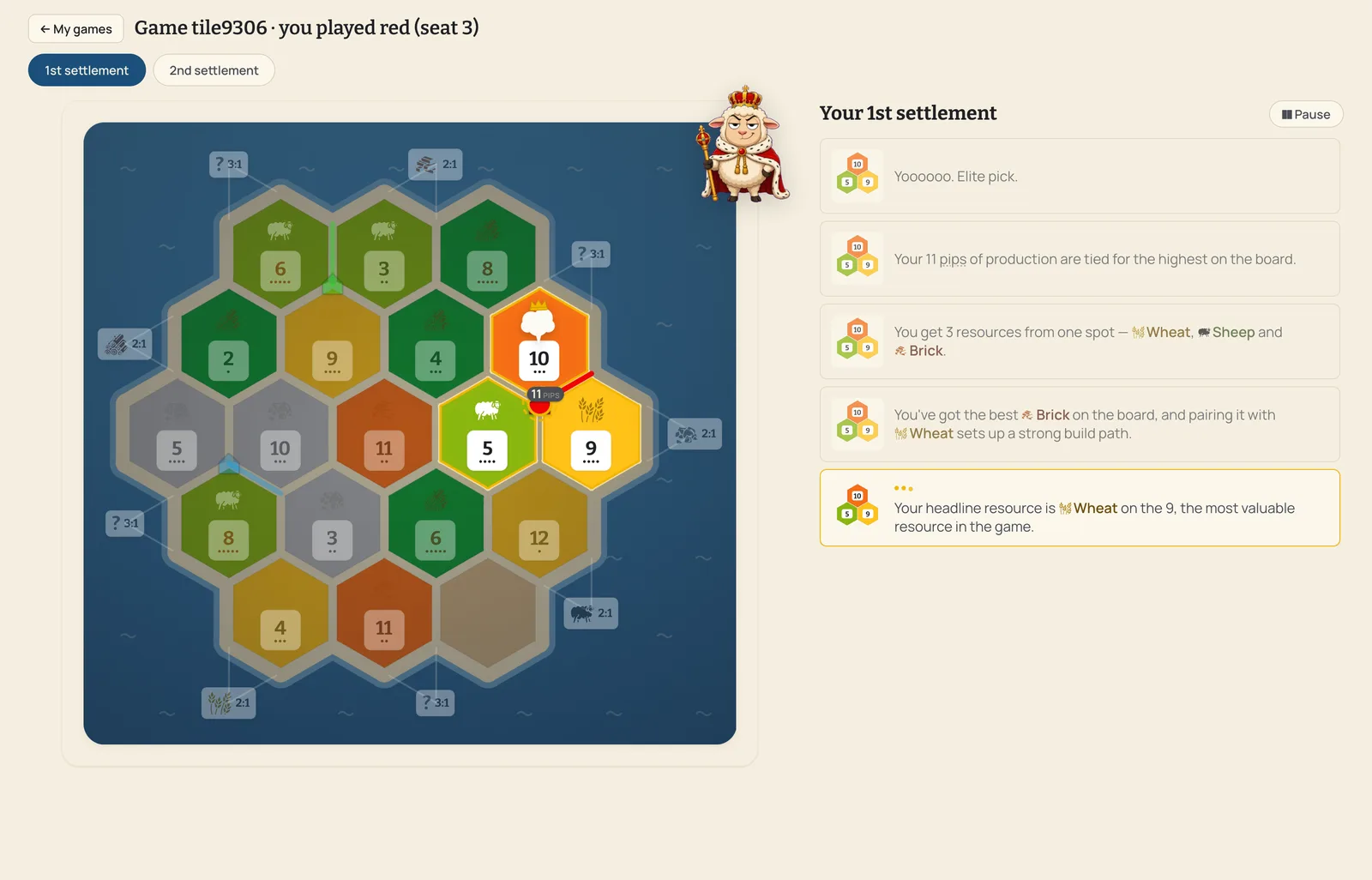
Everything above is easier to do with feedback than with willpower. Catan Trainer grades placements in two ways. The practice trainer deals you a fresh board, you place, and an AI coach shows you the best available corner and argues the difference: pips, scarcity, plan, ports, your outs. And the Chrome extension for Colonist captures each game you finish and reviews your real opening against that real board, so the ten losses you meant to study get studied automatically.
The checklist for your next ranked game
- Count pips on every open corner before the timer makes you guess.
- Find the scarce resource on this board and decide whether you need to take it now.
- In 1v1: cover all five resources or a 3:1, and spread across as many distinct numbers as you can.
- Pick the second settlement for the combined position, with a starting hand you can spend.
- Point both roads at corners or ports you can realistically claim.
- Know your next settlement spot before the first roll.
- After a loss, replay the opening. Was there a better corner? Usually, yes.
Review your last ten Colonist games tonight
Connect the Catan Trainer extension once, play like you always do, and get a graded review of your opening after every game. Or drill fresh boards in the practice trainer until the counting is automatic. Free to try.
Connect Colonist →