 Catan Trainer
Colonist.io Ranked Tips: 12 Things That Cost You Rating (and the Fix for Each)
Most Catan advice was written for a table with friends. Colonist ranked is a different environment: a placement timer, dice drawn from a deck, a robber that cannot touch you early in 1v1, a karma score, seasons, and opponents who have played thousands of games. Here are twelve things that quietly cost rating on Colonist specifically, and the fix for each. If you want the bigger picture first, read how to rank up on Colonist.io; if you want to know how the rating itself works, read how Colonist.io ranks and rating work.
1. Letting the placement timer choose for you
If the clock runs out during placement, the client places for you, and it does not count pips. A timed-out placement is the single most expensive mistake on the site because it decides your whole game before a die is rolled.
Fix: evaluate in a fixed order, every game: pips on every open corner first, then which resource is scarce on this board, then your plan, then ports. The order matters more than speed; speed comes from repetition. The full method is in our starting placement guide, and the practice trainer exists to make it automatic.
2. Placing by number instead of by pips
A corner on a 6 and two 11s looks strong and makes 9 pips. A corner on a 5, a 9 and a 4 looks ordinary and makes 11. Over a 70-turn game the second corner produces around 20% more cards. Players who plateau pick the first one every time.
Fix: add the dots. If the dots are new to you, what pips are and why they add up takes five minutes.
3. Believing a number is due because the dice are "balanced"
Colonist's Balanced Dice option is not random dice. Rolls are drawn from a shuffled deck of the 36 two-dice combinations, reshuffled before it runs out, with a reduction on rolling the same number twice in a row. Colonist has written about how the algorithm was designed. Ranked 1v1 uses it, and in 1v1 Colonist also adjusts the chance of a 7 depending on whose turn it is.
Fix: treat the dice as fair for placement purposes. The deck nudges a cold number slightly, briefly, and then reshuffles; it does not make an 11 behave like an 8. Spread across distinct numbers exactly as you would at a table, because a position that only works if the dice "even out" is a position that loses the games where they do not.
4. Treating 1v1 like a four-player game
Ranked 1v1 is to 15 points with almost no trading, Friendly Robber on and Very Fast speed. A three-resource city engine that wins four-player games cannot reach 15 without wood and brick, and every missing resource costs 4:1 or a port.
Fix: in 1v1, cover all five resources or hold a 3:1 port, count distinct numbers before pips, and plan a route to 15 that includes longest road, largest army or development cards from the placement phase. The mode-by-mode table in the Colonist strategy guide spells out the differences.
5. Forgetting what Friendly Robber means in 1v1
With Friendly Robber on, you cannot be blocked or robbed until you openly have more than two points; hidden victory-point cards do not count. Your opponent gets the same protection.
Fix: the first settlement-plus-road you build takes you to three visible points and makes you robbable. Before you do it, make sure the production you are about to expose is spread, not stacked on one hex. And do not waste the early turns trying to rob an opponent who cannot be robbed yet.
6. Stacking two settlements on one red number
In 1v1 the robber lands on your best hex every time your opponent rolls a 7, which is one roll in six. Two settlements sharing an 8 share a problem: one robber stops both.
Fix: six distinct numbers across your two opening settlements is the 1v1 target. In four-player, a deliberate wheat or ore duplicate is fine because the robber is shared among three opponents and tends to sit on the leader.
7. Holding cards into a 7 in 1v1
Colonist's 1v1 hand limit is 9 cards, not 7, and the 7 is the most common roll. Players coming from four-player either discard too early out of habit or sit on ten cards because nobody is trading with them.
Fix: know your limit for the mode, and when you cannot trade down, build down. A road you did not strictly need is better than two cards you were about to lose.
8. Quitting instead of resigning, and resigning too early
Leaving a game costs karma (a public score out of 20 that recovers slowly) and forfeits the rating you were playing for. Resigning is allowed, and Colonist's own 1v1 guide notes that about a third of 1v1 games end with one. But four-player rating is not win-or-lose: finishing second against three strong players is worth something, finishing fourth costs.
Fix: in 1v1, resign a genuinely lost position rather than disconnecting. In four-player, play on for second and third; that is where a lot of rating is made. And never make a habit of quitting games you are losing, which Colonist's guidelines call out by name.
9. Reading the opponent's rating instead of the board
A higher-rated opponent did not get lucky more often. They placed better, more often. The board in front of you is the same for both of you.
Fix: use the rating for one thing only: expect the obvious best corner to be taken before your turn comes around, and plan the draft accordingly. Then evaluate the board as if the rating were hidden.
10. Pointing the free roads at corners you will not get
Each placement road is the only free one you get all game. On Colonist, a road pointed at a contested corner is a road your opponent will make useless by taking the corner first.
Fix: point roads at corners you can realistically claim: the coast, an open interior corner, or a port you can feed. A port you cannot reach without two more roads is a plan, not an asset; the port guide has the pricing rule.
11. Queueing in the last week of the season
The leaderboard shows a countdown, and the final days are when everyone chasing a top finish queues hardest. The author of Colonist's 1v1 guide describes winning 19 of 24 games on the last day to lock a top-50 spot. That is who you meet in the final week.
Fix: if you are still in your ten placement games, or still learning a mode, play early in the season. Save the final week for when you are chasing a specific rank, not for learning.
12. Never reviewing a loss
Colonist keeps the log of every game, and the opening is the one decision you can judge without the dice getting in the way. Players at the top of the ladder re-watch their openings. Players who plateau queue the next game.
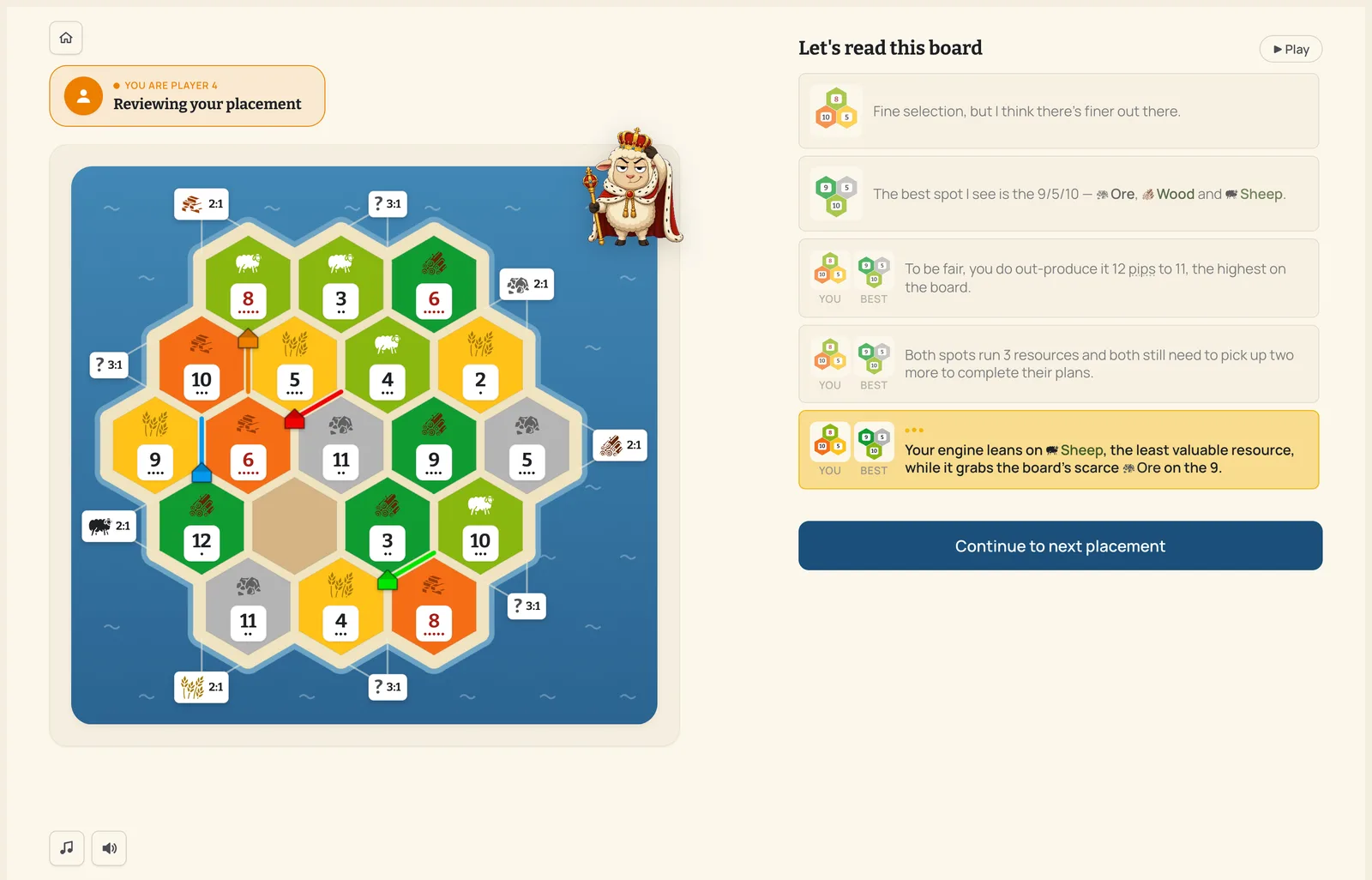
Fix: after a loss, replay the first two placements against the board. Was there a higher-pip corner, a scarcer resource, a port you could have fed? Doing this for ten losses teaches more than fifty games on autopilot. If you would rather not do it by hand, the Catan Trainer extension captures each finished game and grades your opening against the best spots that were available, with the reasons spelled out.
The short version
- Count pips before the timer does it for you.
- Pips, not pretty numbers.
- Balanced dice are not "due" dice; spread your numbers.
- 1v1: cover five resources or a 3:1, plan to 15.
- You are unrobbable until three visible points; so is your opponent.
- Six distinct numbers in 1v1; a wheat or ore duplicate is fine in 4P.
- Know the 9-card limit; build down when you cannot trade down.
- Resign, don't quit; in 4P play for second.
- Read the board, not the rating.
- Free roads go where you can actually build.
- Learn early in the season, chase late.
- Review every loss's opening.
Fix the openings, keep the rating
Eleven of these twelve are habits. Catan Trainer drills the placement habit on fresh boards with an AI coach, and the free Colonist extension reviews your real games after they end. Nothing runs during play, so it stays inside Colonist's rules.
Connect Colonist →